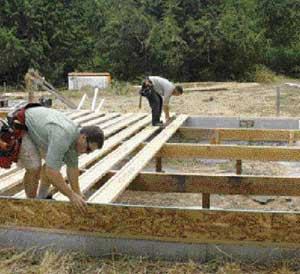
Once we’re about halfway through marking and drilling, one framer breaks off from marking and begins to fasten the sills with nuts and washers. We tighten the nuts with an electric impact wrench, taking care not to overtighten them.
Straps are faster. Not long ago, we stopped using anchor bolts and started using a type of cast-in strap that wraps over the sill and is fastened to it with nails. We happen to use Simpson’s MA6 anchors, but USP makes something similar, the ST1-TZ.
On our crew, one carpenter cuts and places sill stock on the foundation, a second follows behind and tacks the sill on layout with a powder-actuated tool, and a third makes the structural connection by bending the straps over the sill and fastening them with a metal connector nailer. We tack down the sills to prevent them from moving while the straps are being nailed.
Using straps is much faster than using anchor bolts because there is no need to lay out and drill holes. Another advantage to using straps is that we never have to move a joist off layout because a bolt is in the way; since straps are thin, you can run joists and rim boards right over them.
To avoid having to use galvanized or stainless steel fasteners, we use borate-treated lumber for the sills (see “Fasteners for ACQ Plates,” Q&A, 1/06). We frame quickly so that the sills are not exposed to the weather long enough for the borate to leach out.
Using Girders to Break Up Spans
Most of the homes in our area are built over crawlspaces, so we install rows of girders 8 or 9 feet apart to break up long floor spans and pick up point loads. This makes for a stiffer floor and eliminates the need for a stem wall at the center of the house.
We don’t do this with basements, however, because that would require too many posts. Instead, we use larger joists, and — when necessary — break up the spans with bearing walls.
The tops of the girders should be flush to the tops of the sills. On large houses we install the sills that are perpendicular to girders first; that way, part of the crew can set girders while the rest of the sills are being installed.
We start by scattering the girder stock so we can cut the pieces where they go. The ends of the girders will be supported by posts that land on ribbon footings (long thin footings) or footing pads.
The footing pads vary in elevation, so each post has to be cut to a slightly different length to keep the girder level. To quickly measure post length, we stretch a string very tightly from sill to sill where each run of girders will be, measure up to it from the footing, and deduct the height of the girder.
If the run is more than 25 feet long, we add 3/16 inch to the height of the center posts to account for the sag in the string.
We have used a rotary laser to determine the height of posts, but that approach is slower than using a string. The laser is more accurate, but our primary objective is for the tops of the girders to be in a straight line between the sills. We don’t care if a run of girders is slightly out of level — say, within 1/4 inch from end to end. (If the stem walls are off by more than that, we shim the mudsills.)
We cut the posts, stand them over a piece of PVC membrane, and install girders on top. The posts are fastened to the footings with cast-in straps and to the girders with nailed 2×4 gussets. We sight the girders before nailing them off; if there is excessive crown, we’ll cut the girder over an intermediate post.
The girders normally stop short of the stem walls, so it doesn’t matter that they aren’t treated. If the ends are less than an inch from the concrete, we cover them with PVC membrane.
Laying Out and Installing Joists
Once the girders have been installed, we clean out the crawlspace and lay out the locations of joists and beams on the sills and girders. To minimize errors, only one carpenter does layout; the rest of the crew scatters the joists and sets beams.
I-joists. We use I-joists about half the time. Our supplier provides a “precut” package based on the plans, so we have to pay close attention to the lengths the manufacturer sends. The joists come several inches long and we trim them on site.
We like to scatter the longest joists first, just to get them out of the way. While one framer installs rim, another uses a forklift to boom the joists over the foundation so that the other two guys can unload them. With the forklift, it takes only about 30 minutes to scatter all the joists for a 1,500-square-foot floor.
If the joists are less than 25 feet long, our preferred method is to use a chain saw to cut them while they’re still banded together; if they’re longer than that, they’ll bend too much and throw off the measurement.
When the joists are more than 25 feet long, we leave off one of the rims, butt them to the opposite rim, snap a line for the cut, and cut them in place with a circular saw. We then install the last of the rim and begin to roll and fasten the joists.
Nailing. We follow the I-joist manufacturer’s recommendation for nailing. We use RFPI Joists (Roseburg Forest Products, 800/347-7260, www.rfpco.com), which require one 8-penny nail through the rim into each flange and two 8-penny nails through the bottom flange (one on each side) into the rim. With solid-sawn joists, we use 10-penny nails to fasten every 1 1/2 inches through the rim into the joists as well as to toenail the joists to the sill.
If we’re using I-joists, the manufacturer supplies precut I-joist blocking, or LVL blocking when the engineer says it’s necessary. With solid-sawn joists, we use solid lumber blocking.
Sometimes we’re required to install double blocking under shear walls, in which case we make the blocks out of cutoffs from the 4-by girder material.
Inspection
The building inspector needs to inspect the frame before we install subflooring. Framing the floor normally takes us five or six hours, so we schedule an inspection for the afternoon, and unless there are major problems we can sheathe the floor as soon as he leaves.
If the inspector asks for anything, it’s usually that we add a few more pieces of framing hardware to tie the rim to the sill or that we add some extra anchor bolts to the foundation. When we need to add anchor bolts, we use 1/2-inch Kwik Bolts (Hilti, 800/879-8000, www.hilti.com), a type of wedge anchor.
If at all possible, we sheathe the floor and snap out the walls on the same day. That way, we can start framing the walls first thing the next morning. If we aren’t finished when the inspector comes out, we have to call in for another inspection and we lose the next day on the job.
Laying the Floor Sheathing
When we install subflooring, everyone sticks to a particular task until the floor is done. Since there are four of us, the first carpenter applies the glue, and a second packs material and beats the sheets together so that the T&G joints will close (Figure 9). A third packs material and cuts, and a fourth does nothing but nail.
We trade off on every house so that no one has to do the same thing all the time.
Gluing is the weakest link in the process. Even with a pneumatic glue gun — which is way faster than operating a gun by hand — the guy doing the gluing has to hustle to stay ahead of the rest of the crew.
We’re very production-oriented about this; on a recent project we installed the subfloor on a 3,000-square-foot single-story home (95 sheets) in a little less than two hours, including trimming the edges.
During the drier months of the year, we sheathe floors with LP’s midlevel OSB product, TopNotch Orange Plus (888/820-0325, www.lpcorp.com).
But during the rainy winter months, we’ll spend the extra $3 to $4 per sheet it costs to get AdvanTech (Huber Engineered Woods, 800/933-9220, www.huberwood.com), which is less likely to swell when it gets wet.
Tim Uhler is a lead framer for Pioneer Builders in Port Orchard, Wash., and a JLC contributing editor.