1
of 4
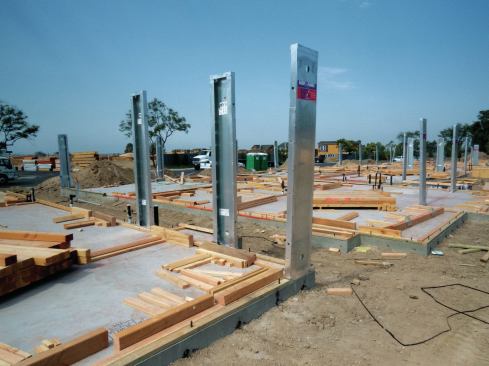
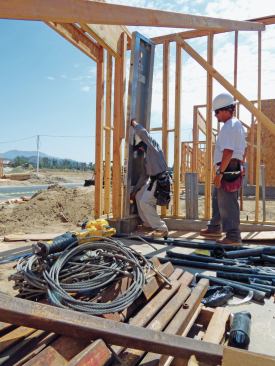
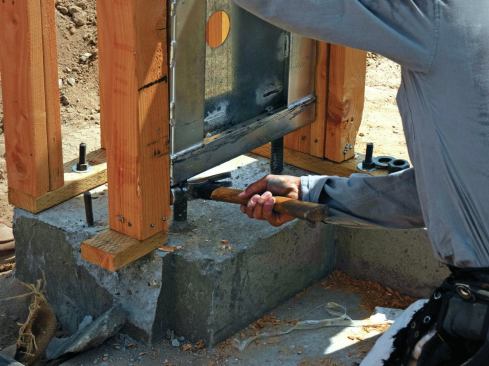
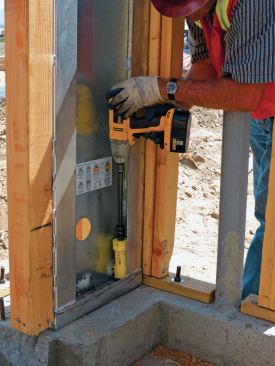
Framers typically set panels before they stick-frame the surroun…

Framers typically set panels before they stick-frame the surroun…
New construction is one thing, but in the years to come, contractors will face a much more complicated challenge: plugging shear-wall and moment-frame components into existing buildings.
Investigators in California noticed a common mode of failure in many buildings after the Loma Prieta (1989) and Northridge (1994) earthquakes: A “soft story” on the building’s first floor buckled and failed, and the building’s upper stories fell to the ground. According to Dan Friedman, who was in L.A. just weeks after the Northridge earthquake (see “Eight-Penny News: Earthquake Aftermath: On-Site Report,” April/94), “Collapsing second stories reduced parking areas and, in some cases, first-floor apartments to as little as a few inches in height, resulting in a record number of deaths.”
Years later, federal, state, and local governments are getting serious about addressing the “soft story” problem. San Francisco passed a city ordinance on April 18 this year (the anniversary of the 1906 earthquake) requiring mandatory retrofits of thousands of buildings in the city to strengthen “soft story” first floors. San Francisco’s new law will apply only to buildings with five or more apartments built before 1978. But that’s still a lot of work.
Simpson Strong-Tie engineers say their new Special Moment Frame is tailor-made to address the problem. Unlike earlier types of steel moment frames, the Special Moment Frame is connected at column-to-beam joints with a tab of softer steel that is designed to bend and give in a way that will absorb the energy of an earthquake without subjecting the frame’s main members to the quake’s full force. Standard steel moment frames, says Simpson engineer Steve Pryor, absorb the energy in the main beam of the frame instead. “When the steel in the beam starts yielding, it becomes soft throughout its whole depth,” Pryor says. “So you have to hang onto it so that it doesn’t buckle and move sideways. … That stability bracing is critically important in a seismic event.”
But this bracing is a problem when retrofitting wood structures. “When you’re putting steel frames in wood buildings,” Pryor says, “you cannot anchor your brace into the wood floor next to the beam strongly enough to stop that twisting and buckling. So the Special Moment Frame technology that we have developed is a game changer because the special fusible links, top and bottom, do all the bending, instead of the rest of the frame. You don’t have to worry about this twisting and buckling problem.”
The company offers designers a range of solutions. Its wood Strong-Wall was its first entry into the field. Made with 2×4 or 2×6 studs and OSB faces, the components come in a range of widths (18, 24, 32, and 48 inches), and at heights suitable for framing an 8-foot, a 9-foot, a 10-foot, or a 12-foot wall, taking plate thicknesses into account.
For greater strength with a narrower wall, Simpson developed the steel Strong-Wall, substituting a corrugated steel panel for the OSB shear panel of the wood version. Available widths are 12, 15, 18, 21, and 24 inches, and there are eight available heights: 80, 85 1/2, 93 1/4, 105 1/4, 117 1/4, 129 1/4, 141 1/4, and 151 1/4 inches.
Falling between the wood Strong-Wall and the steel Strong-Wall—in width, structural capacity, and price—is the Strong-Wall SB Shearwall, originally developed by Trus Joist and formerly marketed as the Trus Joist TJ Shear Brace. Simpson Strong-Tie purchased the product line from Weyerhaeuser in February 2013 and is launching the rebranded component into the market this fall. Based on a laminated strand lumber (LSL) column, the Shear Brace comes in widths of 12, 18, and 24 inches, and in heights ranging from 7 feet up to 20 feet high. Conveniently, the Shear Brace is field-trimmable to custom heights—just order the next greater size and cut the top to fit.
Simpson Strong-Tie also offers two types of prefabricated steel moment frames: the Ordinary Moment Frame and the Special Moment Frame. Moment frames cost more than prefab shear-wall panels but supply the greatest structural capacity, as well as the narrowest wall profile. The Ordinary Moment Frame has rigid corners and is well-suited to hurricane situations, where it’s expected to stay stiff while standing up to the wind pressure on the house. The Special Moment Frame, introduced by Simpson just a year ago, was developed to address earthquake situations. A special ductile connection tab at the frame corners will yield under stress to protect the frame’s main members from damage and allow for a quick post-earthquake repair in place.
There are two flavors of manufactured shear wall offered by Hardy Frames: a “Panel” version made with continuous sheet steel; and a “Brace Frame” version made with steel vertical members and a diagonal cross-brace.
The Brace Frame, offered in widths of 32 and 44 inches, is the lower-cost and lower-capacity alternative for situations where wall length allows a wider component; the higher-strength, narrower Hardy Frames Panel is available in widths of 9, 12, 18, and 24 inches.
Hardy Frames’ Moment Frame, made of steel I-beams, was the first prefab moment frame to gain a code listing. Standard sizes are available for opening widths from 1 foot up to 23 feet wide, and various opening heights (non-standard sizes require a special order).
The wood-based Shearmax panel is Shearmax’s one flagship product. The product’s unique design gives it a relatively high capacity for a wood panel: The OSB panel is set into a routed rabbet on the inside edge of the Doug fir 4×4 frame, so that wood-to-wood contact supplements the strength of the nails attaching the sheathing element to the frame. Light-gauge steel flanges around the perimeter of the frame add strength but maintain the “ductility,” or capacity to yield, that allows the panels to function well, even at very high aspect ratios. Shearmax also developed an outside-mounted bracket with a small offset, which company engineer Tim Timmerman says transmits forces more efficiently from the foundation to the frame.
Shearmax panels come in nine standard widths (16, 18, 21, 24, 28, 32, 36, 42, and 48 inches), and the company can produce custom lengths up to 20 feet at no extra charge (odd widths are also available as a special order, but cost more). The panels can be custom cut in the field, either square or, if necessary, at an angle to match a roof rake.
Ted Cushman is a freelance writer based in Peaks Island, Maine. He is editor of the Coastal Contractor newsletter and has been a regular contributor to JLC since 1993.

No recommended contents to display.