
Practical Engineering: Resisting Tornado Damage, continued
A breach in the garage door opening of this home first pressurized the inside of the garage, resulting in devastating failure of the garage walls and the home’s roof. In a similarly built home nearby (bottom), the garage door was bowed outward by the tornado’s suction. The door held, preventing further damage to the home.
This plywood-sheathed house (top) fared much better than another home (bottom), which was sheathed with non-structural rigid foam board. Rigid foam offers no racking resistance, and little resistance to damage from flying debris.
Vinyl siding and extruded polystyrene sheathing were no match for flying debris, which pierced holes in this dormer.
By contrast, the plywood sheathing on this home remains intact, although the vinyl siding is in tatters. Though this OSB sheathing also fared well, it couldn’t completely stop a flying pipe.
An initial breach at a large window resulted in internal pressurization and loss of the roof structure over the vaulted ceiling of this stairway. The rafters had been toenailed in place.
Here, in a home still under construction, a breach resulted because a pair of French doors were poorly fastened into the rough opening.
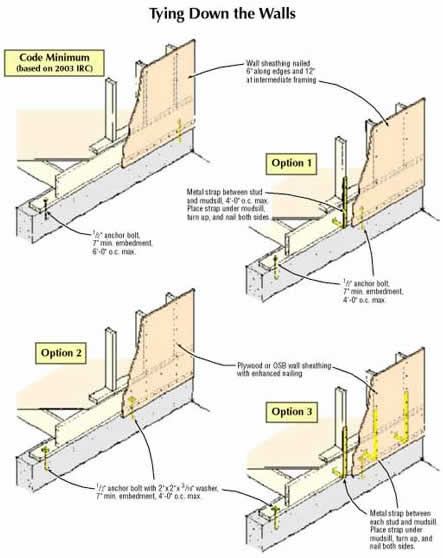
The hold-down anchors weren’t adequate to keep this home from shifting 5 feet off its foundation.
The anchor bolts in this slab-on-grade foundation below were located 20 feet on-center and had no washers; none of the structure was left.