
New Tools, Better Results
These air leaks seldom get addressed during traditional home improvements because they’re not visible from inside the conditioned space; they’re concealed inside framed cavities, behind drywall or plaster. But with modern diagnostic tools, it’s possible to find them and to complete an accurate, detailed heat-loss assessment of a home in just a few hours.
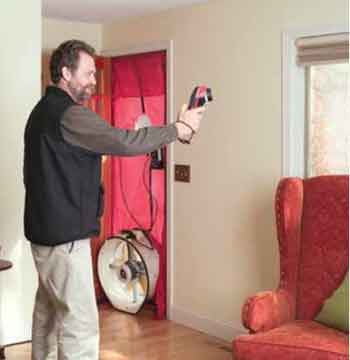
Using an infrared thermal camera in conjunction with a blower door, an energy auditor can identify leaks in the air envelope and insufficient or missing insulation in the thermal envelope.
On a typical job, I first set up the blower door and depressurize the house to 50 pascals, relative to the outside. This approximates the range of pressures a building would be subject to on a very windy night and helps establish a consistent benchmark for comparing the leakiness of one building with that of another.
The blower-door fan draws outside air in through penetrations in the shell and exhausts it through an entry door. The calibrated fan measures the cubic feet per minute of airflow required to maintain the 50-pascal pressure difference between inside and out. The draftier the shell, the higher the flow in cubic feet per minute. Simple math helps us convert the cfm reading to a whole-house air-exchange rate, stated in air changes per hour.
With the blower-door fan running, I make a visual inspection of the home, looking for any obvious leakage spots. A smoke pencil — a handheld device that emits a stream of chemical smoke — helps in tracing drafts.
After the blower has been running for a while, drawing in cold outside air, I take another tour through the house, this time using the infrared camera to scan for hidden air leaks and thermal bypass problems. The thermal image viewed through the camera reveals the radiant temperatures of the surface scanned. Since the R-values — and therefore the resulting temperatures — of an insulated bay and the adjacent wood framing members are different, it’s simple to identify the framing details as well as weak spots in the insulation (Figure 3). Thermal scans often reveal areas where the insulation has settled or is not dense enough, and wall and ceiling bays that were completely missed when the insulation was installed.
Because the blower door is drawing in cold air from the exterior or attic, the scan can identify and measure areas of air infiltration, recognizable by a plumelike thermal pattern.
The scans also show areas where the wall surface has become chilly, indicating that the cold air is moving through or beneath the insulation. These spots are common on ceilings near the eaves, due to the effects of wind-washing (outside air moving into the eaves and through the fibrous insulation), but they can also show up in interior locations where you might not expect to find them.