In preparation for mounting the track for the barn-style doors, …
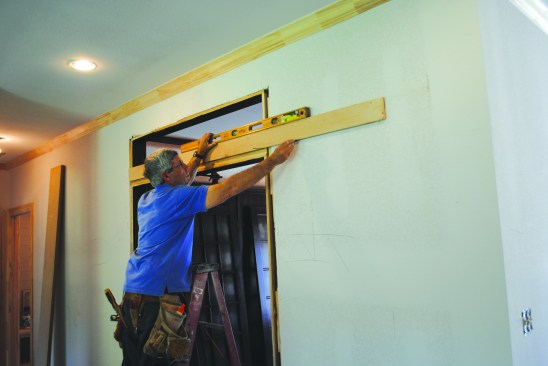
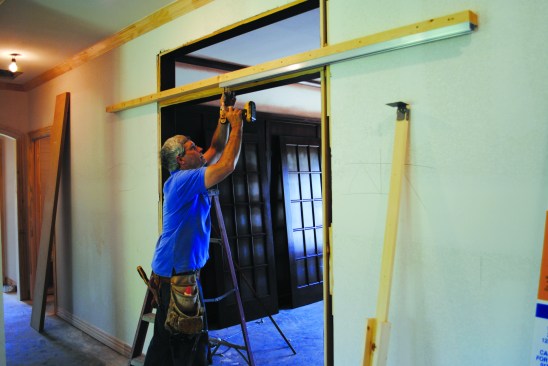
In preparation for mounting the track for the barn-style doors, the author drew a level line across the opening and onto the walls at the appropriate height.
He then ripped a 2×6 in half and, using his line as a reference,…
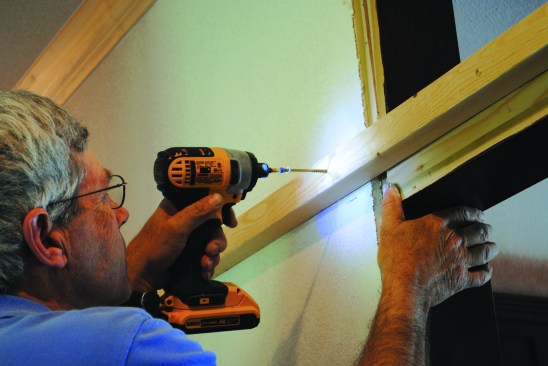
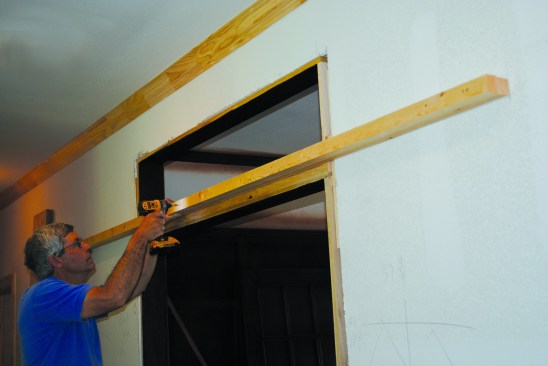
He then ripped a 2×6 in half and, using his line as a reference, centered the first piece on the opening and screwed it to the wall framing.
Screwing the second ripped piece to the first with the bottom ed…
Screwing the second ripped piece to the first with the bottom edges flush to each other created a 3-inchwide header to attach the track to.
Using a reciprocating saw, the author cut the track from a stand…
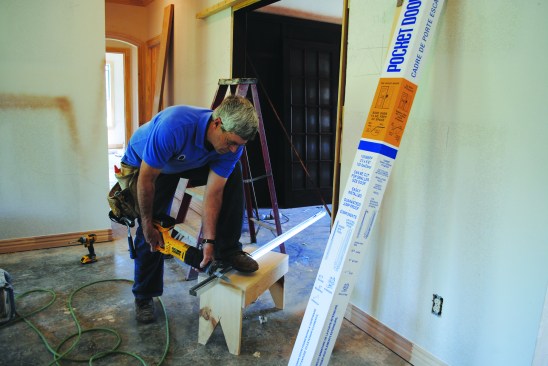
Using a reciprocating saw, the author cut the track from a standard lumberyard knock-down pocket-door frame into 62 3/4-inch lengths for each side, which would leave a space for inserting rollers in the middle.
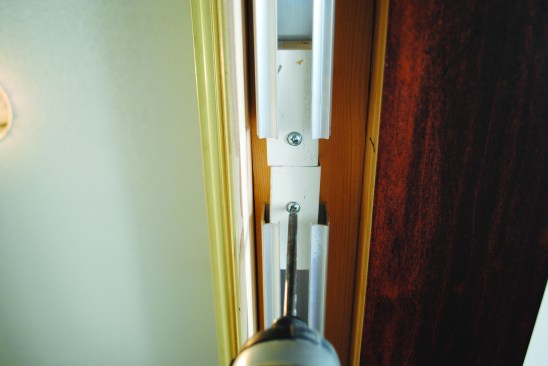
The track sections were screwed to the split header flush with b…
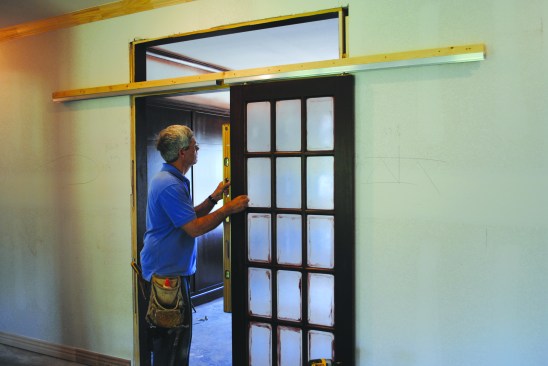
The track sections were screwed to the split header flush with both ends and flush with the outside edge of the track. This positioning left enough space for the doors to clear the jamb casing when they opened and closed.
After screwing the roller hardware to the top of the door panels…
After screwing the roller hardware to the top of the door panels, the author slipped the first door panel into the track and leveled it.
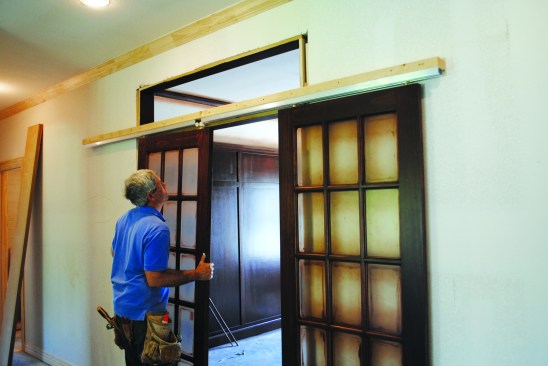
The rollers for the next panel slipped through the gap between t…
The rollers for the next panel slipped through the gap between the track pieces, allowing that panel to slide into the track on the other side.
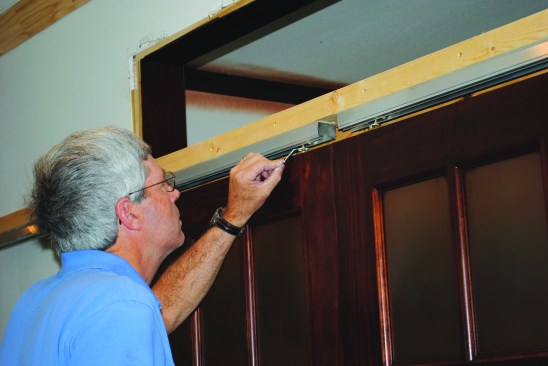
A tiny wrench that came with the pocket-door kit was used to adj…
A tiny wrench that came with the pocket-door kit was used to adjust the height of the second panel until the two panels lined up perfectly. Adjusting the doors on the exposed track was much easier than adjusting a regular pocket door.
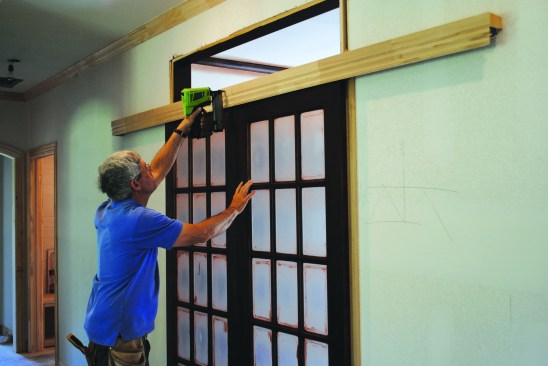
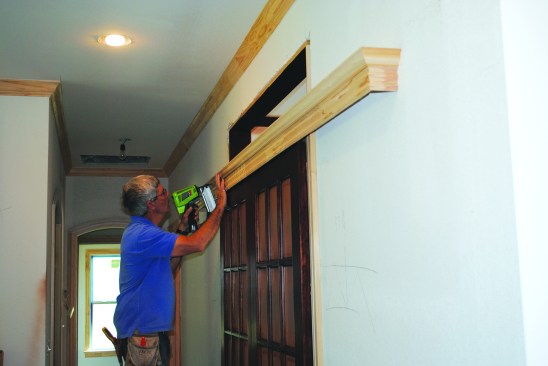
To hide the track assembly, the author nailed trim to the header…
To hide the track assembly, the author nailed trim to the header. Almost any kind of trim could be used, but for this project, a length of inverted baseboard created the first layer.
Next, a layer of panel molding was added along the top edge.
Wooden blocks ripped out of 1-by poplar were screwed in at both …
Wooden blocks ripped out of 1-by poplar were screwed in at both ends of the tracks as well as in the middle to act as stops to prevent the rollers from dropping out of the track in the middle, and to keep the doors from hitting the trim returns at the ends.
I first saw options for barn-door (or rolling-door) hardware a few years ago, at a Custom Service Hardware booth at a trade show. So for my first rolling-door job, I gave them a call, and they set me up with everything from the track right down to the guides and stops. That first job led to several others, including one for which the client requested the look and function of a barn door, but without the decorative hardware. I decided to use pocket-door hardware—modifying the standard track and rollers—combined with barn-door guides.
I recently had a second chance to apply that method, to a pair of 15-light rolling doors at the entrance to a paneled study. The opening had a transom, and the mix of hardware enabled me to leave the transom completely open, without doors swinging into the adjacent hallway.
I made the opening 62 inches wide for the 32-inch door panels, which gave me an inch of overlap on each side—a prerequisite for any barn-style door. Adding the height of the door panels to that of the hardware and track, along with 1/2-inch for clearance space at the bottom gave me the height for the track. The length of the header over the doors was simply the width of the door panels times two, or 128 inches.
When I was done with the doors, the trim was painted to match the rest of the room. The exposed doors looked fantastic—it would have been a shame to have hidden them in the wall.
Gary Striegler, a JLC contributing editor, owns Striegler and Associates in Fayetteville, Ark., and teaches workshops at the Marc Adams School of Woodworking.