
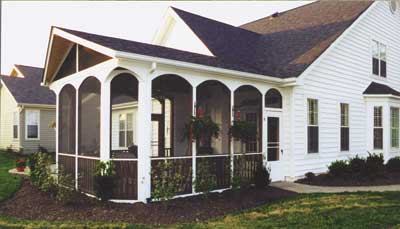
Building Screen Porches, continuedFloor framing. Whether we’re building a deck or a porch, we run the floor framing on 12-inch centers. Considering that we always use 2-by decking, that may seem like overkill when 16-inch, or even 24-inch, spacing would be acceptable. But 12-inch centers provide a stiffer platform to build the porch on, particularly if the porch structure is set in from the perimeter of the overall deck framing by several feet. I’d rather not have a cluttered-looking forest of posts and pilings below the deck to support the structure.
The added weight of the 2-by surface material — up to double the dead load of 1-by or 5/4 decking — also makes it advisable to beef up the framing. I run my Trex decking on the diagonal and screw it down at alternating edges to reduce the frequency and appearance of surface fasteners. The closer joist spacing keeps the screw pattern tight. Diagonal decking increases the distance that the board must span between joists, so, again, the closer spacing offsets this effect. And although 16-inch spacing may satisfy the code and my customers might not notice the difference, my floor systems are stiff and rugged — no one has ever complained to me about a springy-feeling deck.
Framing the Enclosure
We assemble the pressure-treated porch enclosure system on the deck, using 4×4 uprights to define the openings, a 2×4 bottom plate, and a 1×4 top plate. Our stock black aluminum screening comes in 5×100-foot rolls, so I design the porch with 5-foot-maximum spacing between the upright centerlines. We have a standard 2-8 x 6-9 wooden screen door that we use on nearly every porch. To keep all of the openings at a uniform height around the enclosure, we cut all the uprights equal to the finished height of the door, plus swing clearance. Including the bottom plate, the resulting opening height is 6 feet 11 inches. A 2×4 stretcher at the head of the door opening compensates for the height gain of the bottom plate and provides a backer for the finish trim. On top of the 1×4 top plate, we build a continuous box beam, using a pair of 2x6s flush with the outside of the 3 1/2-inch-wide plate and capped with another 1×4 (Figure 3). We shoot all of these components together in place with 12d galvanized nails. There tends to be some discrepancy between the width of a 4×4 and the width of a 1×4. Because the screening and trim boards will be applied to the exterior face, we’re careful to keep all of the framing flush to this plane.
Figure 3. A box beam lintel consisting of 1×4 plates and 2×6 sides caps the 4×4 posts and runs the entire perimeter of the porch enclosure. |
Building the Roof
The roof configuration depends on the porch design, which is keyed to the style of the home we’re working on. One detail that we use on a straight gable roof has become something of a signature for us. We build what I call a flying gable, which, aside from being attractive, has an important function (Figure 4). Water will penetrate only about a foot or so into the porch along the eaves during a rain, but it can penetrate much deeper through a high screened gable. The projecting “prow” of our flying gable provides a deep overhang that keeps the interior space drier.
Figure 4. The author’s signature “flying gable” roof helps keep windblown rain out of the porch. |
We use treated lumber to frame the roof, too. The rafters rest directly on the 2×6 box beam. If the rafters are to remain exposed on the interior side, we use 5/8-inch T1-11 plywood channel siding, finish face down, to sheathe the roof. The siding provides a finished appearance inside and an adequate nail base for the roofing (it’s thick enough to prevent 3/4-inch roofing fasteners from penetrating through to the interior). For a more formal interior, we’ll frame a flat ceiling and finish it with clear fir T&G edge-and-center-bead paneling. We give the fir three coats of clear urethane finish, or prime and paint it to match the trim of the existing home — either way, it makes a beautiful ceiling. Roofing. We generally use asphalt shingles on the roof, though occasionally we hire a metal roof specialist to install a standing-seam prefinished metal roof.
Railings
Our typical porch railing system consists of a 2×4 sub- and top-rail with 2×2 square balusters. The balusters are beveled at each end and screwed to the wide face of the 2x4s on 4-inch centers. The 2×4 rails are nailed to the inside face of the 4×4 posts, mitered at inside corners. The balusters thus finish up 2 inches inside the outer face of the enclosure (Figure 5). We cap the subrail with a Trex 2×6, notching it fully around the 4×4 uprights. The outer edge of the rail cap ends up flush with the exterior post face. Wider than the 4×4 posts by 2 inches, the 2×6 cap rail overhangs the 2×4 subrail by 1/2 inch on the interior side of the enclosure.
Figure 5. Surface-installed rails and balusters simplify construction and protect the screening from damage by children and pets. Because the screening doesn’t contact the railing or balusters, they are barely visible from outside. | |
An upgrade rail system consists of a colonial profile pressure-treated top-and shoe-rail, installed on-center between posts. The balusters fit into dadoed grooves in the rails.