
Braze Welding
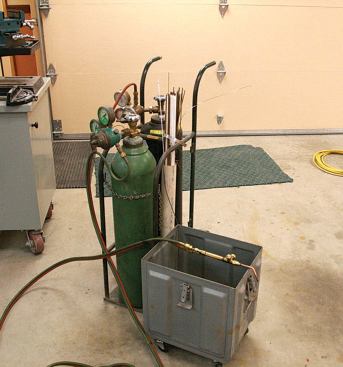
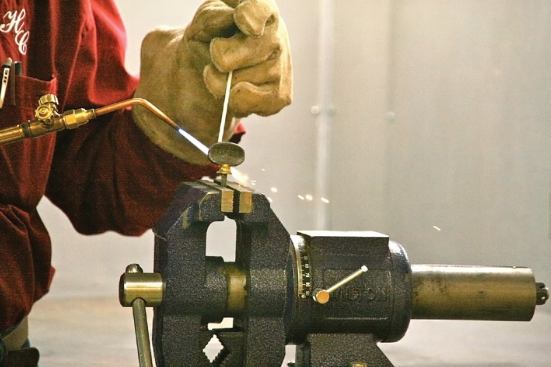
I also have a gas welding outfit that I mainly use for braze welding. Brazing is more like soldering in that the metal parts are not actually melted together. Instead, they’re heated until they’re red, and the braze filler rod melts, acting as a bonding agent. Braze welding is handy when working with small parts or joining dissimilar metals.
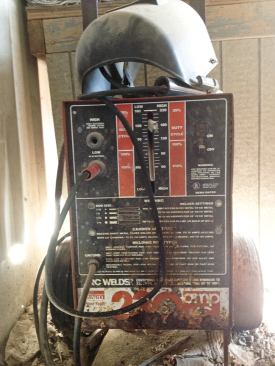
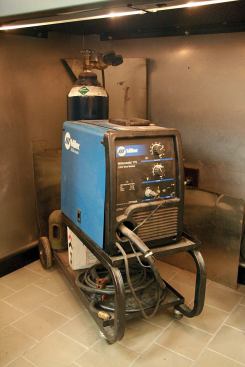
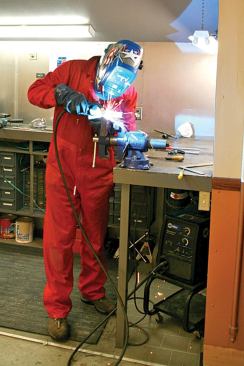
Stick welders are often used with thicker metals and for outdoor…
There are several types of gases that can be used in combination with oxygen when braze welding. I use acetylene, which has a neutral flame temperature of 5,720°F. Some builders consider MAPP gas (methylacetylene-propadiene propane) a safer option, but it’s much more expensive than acetylene and has a lower flame temperature – about 5,300°F.
The biggest cost in buying a gas outfit is purchasing the tanks. I use a 75-cubic-foot acetylene tank, which costs about $150 to purchase and $35 to refill, and an 83-cubic foot oxygen tank, which costs about $210 to purchase and $22 to refill. Since I don’t do a lot of braze welding, the small tanks last me a long time, and they’re light enough for one man to lift into a pickup truck. When they’re empty I simply trade them in at my local welding supply shop for full ones.
I have a Victor brand torch with tips ranging in size from 00 (for 1/32-inch metal) to 5 (for 1/4-inch metal). Since the majority of my gas welding and brazing is on small parts or thin metal, I mostly use my 00 or 0 tips. I paid about $250 for my Victor set, which also includes a cutting torch with a size 3 tip for cutting metal up to 2 inches thick. I mainly use the cutting torch to heat metal for bending, because the cuts aren’t really clean enough for accurately cutting parts to size.
Accessories
For years, I used an old-school welding helmet with a dark lens that left me basically blind until the light from the arc illuminated what I was welding. With this type of helmet, it’s very easy to begin welding in the wrong place. I now use an ArcOne helmet (800/223-4685, arc1weldsafe.com), an auto-darkening welding helmet I bought for about $150 on sale when I bought my MIG welder. There are probably cheaper Chinese off-brands, but I wouldn’t trust my eye safety to them.
Cutting tools. For a carpenter or builder accustomed to working with wood, it’s a bigger challenge to actually cut the metal than it is to weld it together. I’d love to have a metal-cutting band saw or plasma cutter, but just can’t justify the cost for the amount of use they’d get. Fortunately, it’s possible to do a lot of metal cutting with conventional woodworking tools.
For example, I use a Sawzall with well-oiled metal-cutting blades for some of my cutting. I also have metal-cutting blades for a wormdrive saw. Just recently, though, I finally gave in and bought a 14-inch cut- off saw, which admittedly speeds cutting considerably.
Angle grinders are useful for both cutting and dressing up the metal. Grinder wheels are fairly inexpensive, so I have a number of them, from thin cutoff wheels to thicker grinding wheels. Flap wheels – which look like multiple layers of sand paper – work well at removing grinder scratches before painting. And a wire wheel on the grinder helps remove rust from salvage metal before it’s welded and painted.
To hold the metal securely while I’m working, I have a variety of clamps and magnetic welding holders.
Supplies
To find metal for my various projects, I often head over to my local salvage yard. Some of the metal in the yard is new, so if I have a specific need I can usually find exactly what I want. But the company also has a lot of used metal and cutoffs from metal fabricators, which they sell for around 30 cents per pound. This is about one-half to one-third the cost of new, nonsalvage metal.
Tom Hanson is a builder in Spokane, Wash.