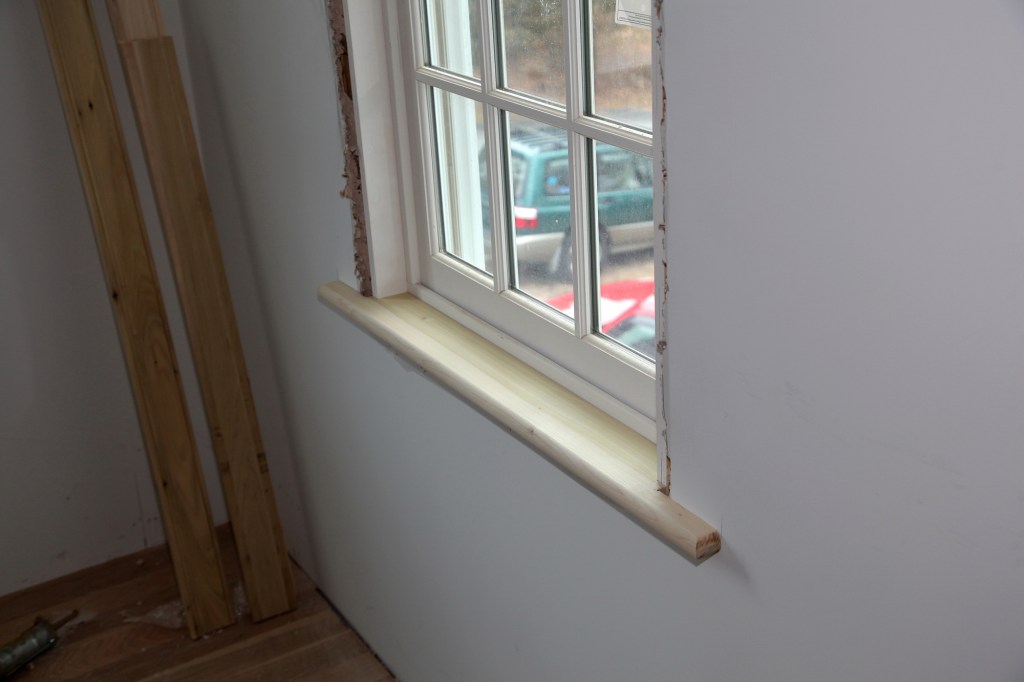
Interior window trim always begins with the stool, or the flat, horizontal part of the trim. I like to think of it as the place where folks typically set a plant. This piece usually involves the most fitting work. A stool has to fit against the wall on both sides of the window, as well as against the window itself or the sill stop in front of the window.
The stool is a landing place for the jamb casings above, and the apron casing fits against the underside of the stool. The stool should always be installed level. It can sit directly on the sill part of the window frame or it can be padded up from the sill of the rough opening. Either way, the finished stool should fit tight against the window stop at a height that looks appropriate with the rest of the window assembly. The stool can be installed before or after the extension jambs.
Stock for the stool can take a variety of forms in a variety of materials. For this article, the stool is made of one-inch-thick paint-grade poplar with a simple bullnose or half-round edge. As with many stock profiles, a dado on the inner part of the stock allows it to sit on the factory sill at the bottom of the window frame.
After the opening is checked for level, the first step is marking the width of the horns, or the parts of the stool that extend out along the wall on both sides. Starting at the inside edge of the side jamb, add the width of the reveal (typically 1/4 to 3/8 inch), the width of the casing, and finally, the amount that you want the horn to extend beyond the outside edge of the casing.
Mark this measurement on both sides of the window and measure between the marks for the overall length of the stool. Rough-cut a piece of stock an inch or two longer than the measurement, for a working length of stock. Now you’re ready to scribe and fit the stool.
Objective:
Demonstrate the process of laying out, cutting, and installing a window stool.
Prerequisite Skills:
Basic understanding of carpentry hand tools and techniques .
Ability to take measurements and transfer them for layout.
Familiarity and basic skills with miter saws, routers, and pneumatic finish nailers.
Tools:
Measuring tape, 6-inch metal ruler, jigsaw, miter saw, router with round-over bit, vibrating sander, pneumatic finish nailer.
Vocabulary:
Stool: Horizontal trim piece installed flat at the bottom of the window trim.
Horn: Part of the stool that extends out over the wall on both sides of the window.
Reveal: The amount of trim element left exposed at intersections of trim or between layers.
Extension jamb: Trim on the inside of the window opening that goes from the edge of the window to the plane of the drywall.