
Elliptical Stairs
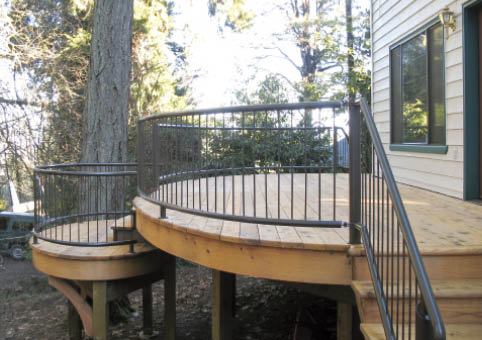
Two staircases, one off each side, provide access to the backyard. Having the stairs follow the curve of the ellipse was actually simple. Since the stringers for a stair are all the same length, the stairs naturally follow the curve of the ellipse.
The stair risers are essentially a smaller version of the fascia. I cut blocking that matched the curve of the deck at the stairs and secured that to the stringers at the top and bottom of each riser (Figure 17). This blocking backs up the risers, which were cut from the same material as the fascia and glued and nailed into place.
I cut the curved treads out of 2×12 redwood, using the risers as guide. After cutting the front edge of the tread in a curve, I glued and screwed the offcut to the back edge so treads were uniform in depth. I used a 3/4-inch roundover bit to create a rounded nosing (Figure 18).
Railing
A local metal company built the curved handrail (Figure 19); to get the right curve, they used full-size cardboard templates on which they had traced the perimeter of the deck.
Mac MacDonald is a deck builder in Portland, Ore.