
Rescuing a Block Foundation, continued
Driving the Piers
Much of our foundation repair work can be done with minimal site disturbance and little excavation; this is one of the main selling points of our services. Still, lifting or stabilizing a sunken foundation requires excavating the area down to the footing. We try to do this with as little damage to landscaping as possible.
Once the area is excavated, the next step is getting the support bracket under the footing. We scrape just enough soil from under the footing to get the 3/4-inch-thick support bracket underneath. We check the footing to make sure that the bottom and the side of the footing in contact with the bracket are relatively smooth, so that the home’s weight is distributed evenly. Sometimes moving the bracket a little to the left or right is all we need to get away from a cobble or other surface irregularity. Unfortunately, on the job shown here, the trench-poured footing was pretty rough, so we had to use a rotary hammer with a chisel bit to square it as best we could.
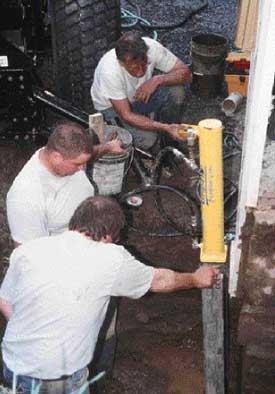
With the bracket under the footing, we slide the first tube into position and set the hydraulic ram into the trench. The ram weighs about 120 pounds and requires all available help. We hook it over the top of the support bracket and connect the hoses to the portable hydraulic pump. The L-shaped bracket, with one of its legs under the footing, prevents the ram from rising as it drives the steel posts.
The tubes are driven at a slight angle with the bottom pointing in toward the house, which distributes the home’s weight more directly over the bearing point. The pipes come in 3-foot sections, but the hydraulic ram can travel only 15 inches at a time, so driving each section is a two-step process.
The hydraulic pump’s pressure gauge shows us when the piers are deep enough; in most cases we stop at about 4,000 psi. In our area, getting to strata with that kind of bearing typically takes three to six pipe sections (9 to 18 feet). One member of our three-person crew controls the pump with a remote control, and it’s his job to keep an eye on the needle. It’s important that the operator is paying close attention because the pressure often shoots up rapidly when the pier enters solid ground. We keep a watchful eye on things and listen to the pump motor while it’s running. A change in the motor’s pitch signals the pump is working harder and can mean the house might start moving. It’s important to go slow and steady; sudden movement can crack a foundation.
Connecting the support bracket to the post requires that the top of the post be cut close to the top of the bracket, so we cut it in place with a reciprocating saw. Because the last section of post (where the bracket is attached) is under the most strain, we add a steel insert for reinforcement, which is also cut to length using a recip saw and a clamp-on guide. Once the reinforcement is in place, we move on to the next pier, following the same procedure until all of the piers are installed.