
Jerry Sutherland
Heat pumps are refrigeration- cycle devices that use electricity…
Sizing Strategies
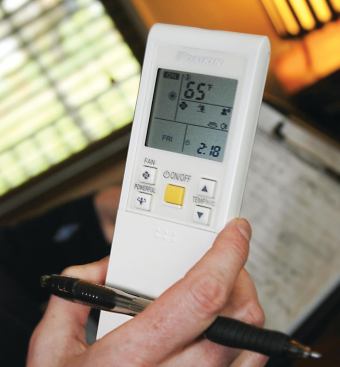
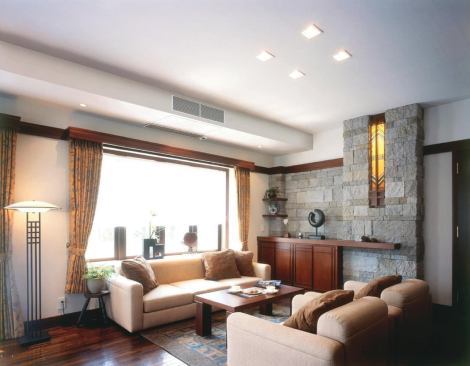
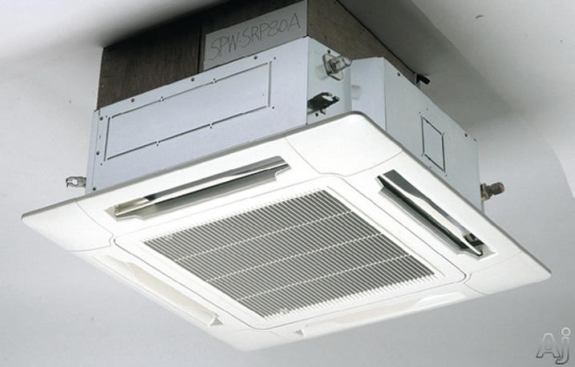
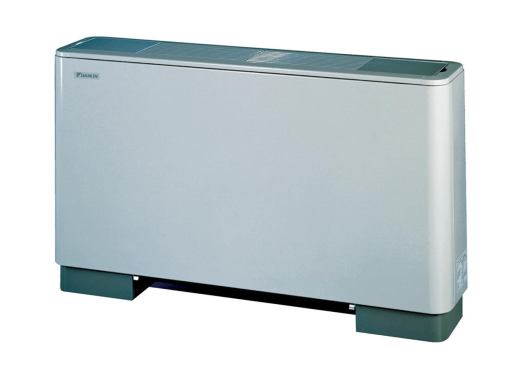
In some respects, the ideal ductless heat-pump configuration is a zoned multihead system. By putting an indoor fan-coil unit in each room or area to be heated, you get the same sort of control over each zone that you would with conventional zoned electric resistance heat. Each indoor unit comes equipped with its own remote control, allowing the residents to tailor the temperature of the main living space and bedrooms to suit their individual preference (Figure 3, page 42).
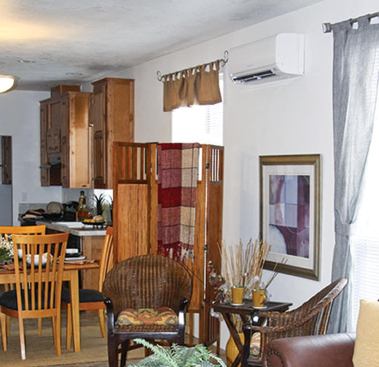
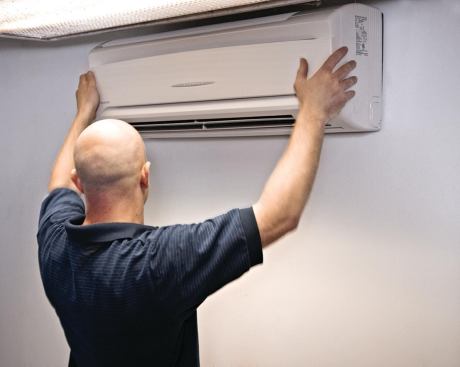
Displace, don’t replace. That approach is standard practice in much of Europe and Asia. In the U.S., however, such systems are less familiar, and many customers balk at the cost and the thought of having to look at a fan coil in every room. Although we do install some multizone systems, single-zone systems — in which one fan-coil indoor unit is placed in an area of the main living space where it can distribute conditioned air across a wide area — are by far our biggest seller.
In this application, the centrally located indoor unit is responsible for the baseline heating load, and the existing zonal electric heaters provide additional heat to outlying rooms as needed. Energy-use data collected from homes in the NEEA program show that the DHP typically provides all the heat needed during the swing seasons of the year, with the resistance heat coming into play only during the coldest months. This is known as the “displace, not replace” strategy, since the intent is to shift as much of the heating load to the heat pump as possible, without removing the resistance units entirely. Customers who really hate the appearance of their wall or baseboard heaters may be able to remove them from rooms served by a fan coil large enough to handle the worst-case heating load, but I always recommend that they hold off on doing so until they’ve lived with the DHP through at least one severe winter.
Cost and capacity. Today’s homeowners are very cost-conscious. As a result, a lot of contractors will try to keep the upfront cost to a minimum by specifying a DHP system just large enough to heat and cool the main living area where the indoor unit will be installed.
We too will do that, if the room layout makes it impractical to move heated or cooled air to other parts of the house, or if that’s what the customer wants. But if we can use the blower on the indoor unit to provide significant airflow to outlying areas that would otherwise be heated by the resistance heaters, we usually recommend going with a larger unit. Most of the systems we install are rated at 15,000 to 24,000 Btu. Increasing the size of the DHP does carry a higher cost, but a lot of extra capacity is available for a relatively small price bump. In our area, for example, the installed cost of a 12,000-Btu DHP — including state sales tax — is about $4,000. Going with a 24,000-Btu unit would increase that figure by only about a thousand dollars.
Of course, the by-the-book approach to sizing conventional hvac equipment (the “book” in this case being the ACCA’s Manual J) is to perform a heating- or cooling-load calculation for the conditioned space, then choose a unit just large enough to handle the resulting design figure. But with a DHP powered by an inverter-driven compressor — the only kind we sell — there’s no need to closely match output and load, because it’s designed to operate continuously over a wide range of speeds. Rather than shortening its operating cycle in response to reduced demand for heating or cooling, the unit simply increases or decreases output as needed, like cruise control in a car.
And remarkably, as a DHP slows down, its overall efficiency actually improves. An oversized unit that’s loafing along, in other words, will use less energy per Btu of output than a smaller one running at near capacity.
In short, when it comes to sizing a DHP, bigger is usually better. A larger model not only operates more efficiently, but the added heat it provides reduces the need for the costly zonal resistance heat that would otherwise pick up the slack. The inherent flexibility in a DHP system is also useful if the homeowner later adds to the heating load by adding on, or subtracts from it by improving the building envelope or beefing up the insulation.