
Charles Wardell
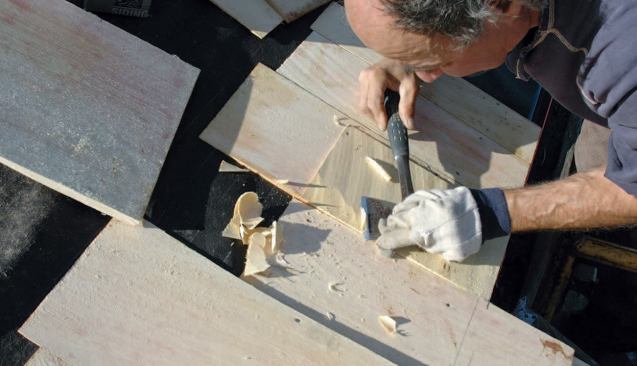
The author demonstrates the weaving details that set his jo…
I’ve been in the roofing and siding business for 30 years, and during that time have installed hundreds of cedar shingle roofs. They’re a great option in coastal New England, where I live and work, and are a natural fit for the area’s many capes and shingle-style homes. Also, a lot of the homes we work on are just steps from the Atlantic Ocean and have to endure frequent high winds. Knowing that wood shingles are more wind-resistant than asphalt helps us sleep better during winter storms.
On the downside, a wood roof costs more than an asphalt one – about twice as much, on average. And a good cedar roof’s service life of around 30 years trails the 35 years you can expect from today’s best architectural-grade asphalt shingles. Still, for many of our clients, the pros of wood outweigh the disadvantages.
A few years ago JLC published a good introduction to shingle roofing (see “Roofing with Cedar Shingles,” 11/09). It went into great detail about how to choose the right shingle species and grade, and provided an overview of what goes into a shingle roof system. Instead of covering the same ground here, I’ll explain how our production techniques help keep costs down on what’s already an expensive roof, and describe how we weave hips and valleys – elegant touches that help our jobs stand apart. Compared with open hips and valleys, weaving is time-consuming, and it has to be estimated correctly if you want to make a profit. To help with that, I’ve provided a cost breakdown at the end of the article.
Working with Alaskan Yellow Cedar
Red cedar shingles are most common in this area, but recently we’ve been getting more jobs that specify Alaskan yellow, as on the house shown here. These shingles are a full 18 inches long, like cedar perfections, but thicker – 5/8 inch, compared with less than 1/2 inch for perfections – which I think looks better. They’re also denser than red cedar, so they’re tougher to cut and trim but also less likely to split.
Flashing and Underlayment
We use lead-coated copper flashing, which doesn’t react with the lead typically used by masons around chimneys. Also (although it’s not an issue on this roof), raw copper reacts with red cedar – another reason lead-coated copper is our metal of choice.
It’s well known that cedar shingles last longest when installed over a ventilating underlayment. The traditional way of doing this was to install them over horizontal strapping, but that’s rarely seen anymore. We recommend Cedar Breather as a good alternative, but many contractors and homeowners don’t want to add it to the roofing budget. So on most of our jobs, we cover the roof sheathing with 30-pound felt (rather than the 15-pound felt we use under asphalt shingles), and line all eaves, rakes, and valleys with Ice & Water Shield.