The author demonstrates the weaving details that set his jo…
The author demonstrates the weaving details that set his jobs apart and the production methods, such as using a shingler's hatchet, that help him keep his prices competitive.
Charles Wardell
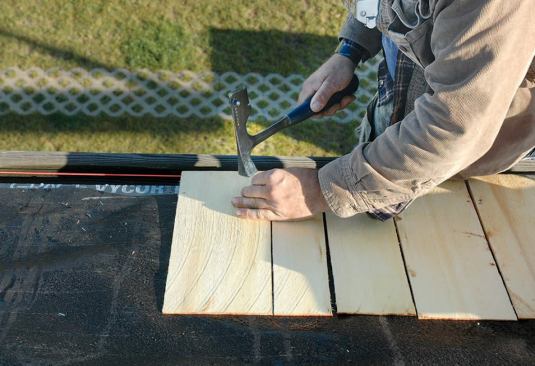
The first starter course is set to a string line.
Charles Wardell
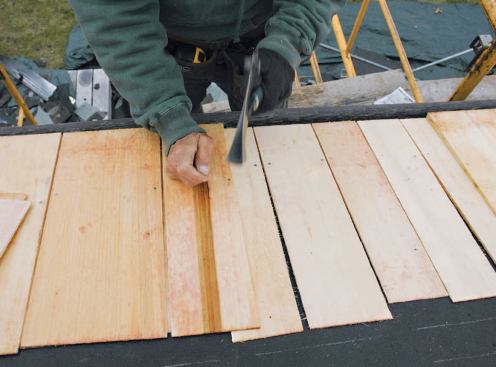
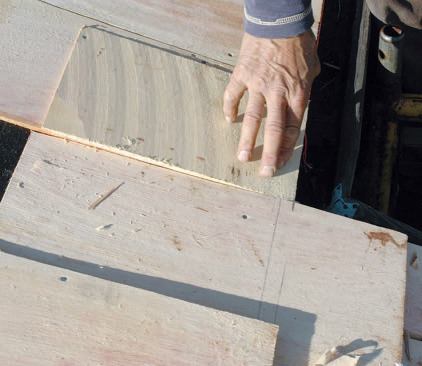
A second starter course is laid with minimum 2-inch offsets betw…
A second starter course is laid with minimum 2-inch offsets between keyways.
Charles Wardell
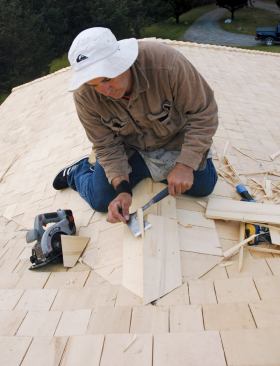
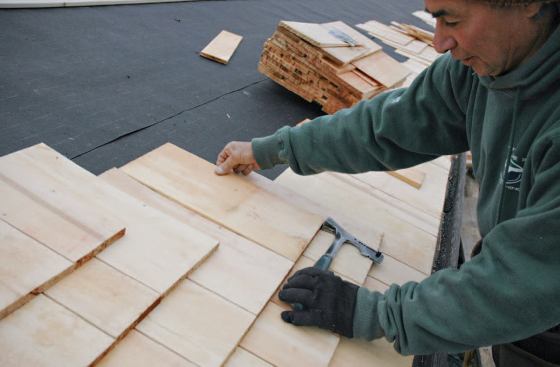
On a typical job, each carpenter works a section of the roof, wh…
On a typical job, each carpenter works a section of the roof, which helps avoid confusion; courses are checked regularly and adjusted as needed.
Charles Wardell
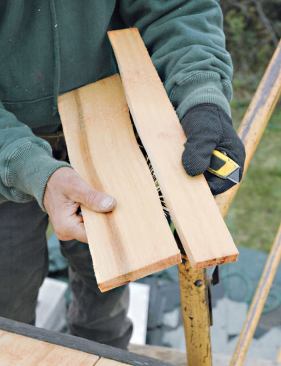
The Alaskan yellow cedar shingles shown here are thicker and den…
The Alaskan yellow cedar shingles shown here are thicker and denser than red cedar shingles and somewhat more difficult to split.
Charles Wardell
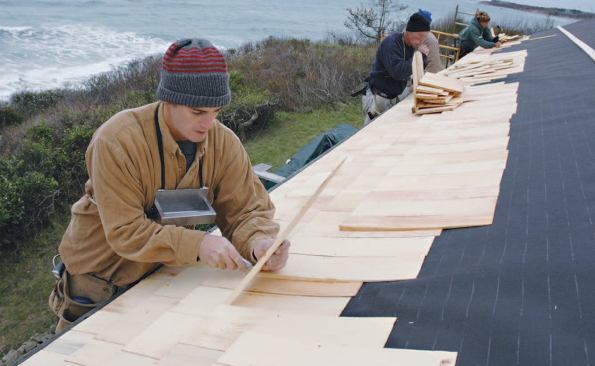
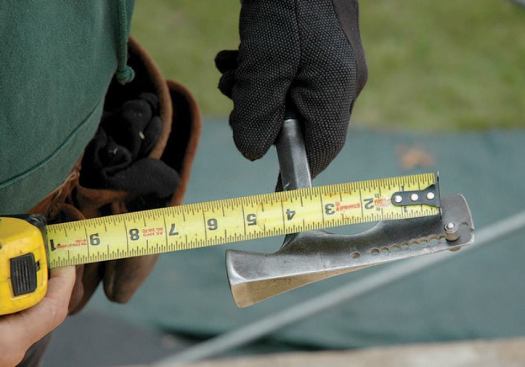
The author uses the gauge button on the shingling hatchet to lay…
The author uses the gauge button on the shingling hatchet to lay out courses. The hatchet comes with buttonholes every 1/2 inch; he heats the blade and uses a drill press to make additional holes at 1/4-inch increments, which is enough to handle any spacing variations.
Charles Wardell
The hatchet is much faster than wood strips for lining up course…
The hatchet is much faster than wood strips for lining up courses.
Charles Wardell
Charles Wardell
Weaving Hip Caps
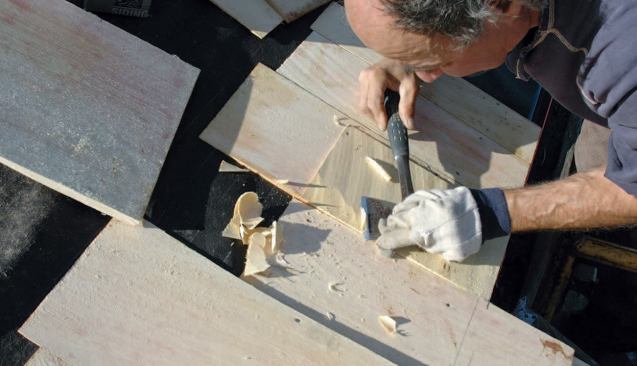
Unlike a standard hip cap, which sits on top of the shingles and leaves a gap underneath, a woven cap is tight to the roof surface. Because every shingle has to be trimmed and planed, we hand-select shingles with straight, open grain – ones that will split straight and are easy to trim. Every shingle is fitted in place and trimmed to lie flush to its neighbor. It’s slow going, and even slower with Alaskan yellow cedar, which is denser and more difficult to plane than red cedar. But whatever the wood species, the steps required for a tightly woven cap are the same.
We bring the field shingles to the hip and snap lines on both sides to indicate the edges of the cap. At the bottom, we run the two starter courses to the corner from each side (see slideshow). We then follow with two more pairs of hip starters, which are oriented diagonally up the hip, and which we trim with a circular saw to follow the eaves. Now we can work up the hip.